SACE Requirements: Eligibility, Qualifications and Documents Explained
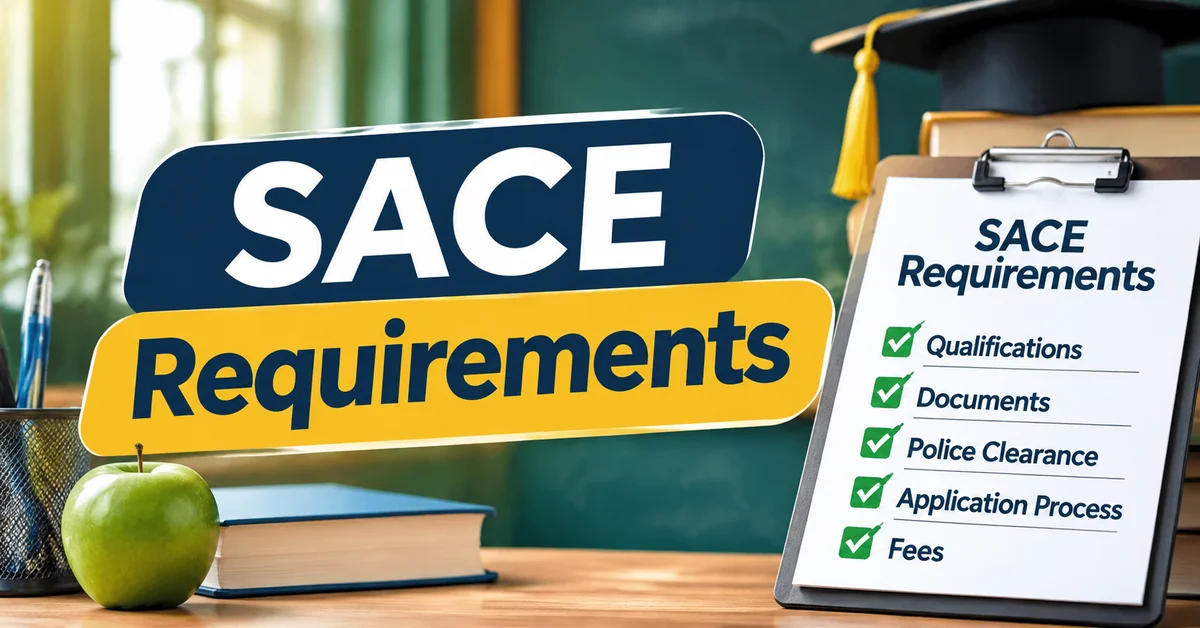
SACE requirements are the conditions you must meet to be registered with the South African Council for Educators. In short, you need valid proof of identity and a recognised teaching qualification, or current enrolment in a teacher education programme. You also need to pass SACE’s fitness-to-teach screening and submit the documents required for your category.
This article explains each requirement in detail: who is eligible, which qualifications count, which documents are commonly requested, what applies to student, provisional and foreign-qualified applicants, and what you must keep doing after registration. SACE sets and updates its own rules, so always confirm the current checklist on www.sace.org.za.
SACE Requirements at a Glance
| Requirement type | What it means | Applies to |
|---|---|---|
| Identity | Certified copy of SA ID, or passport for non-citizens | All applicants |
| Qualification | Recognised teaching qualification (full) or proof of enrolment (student) | All applicants, in different forms |
| Fitness to teach | Honest declarations and a police clearance where SACE requires it | All applicants |
| Payment | Any applicable application or registration fee | Most applicants |
| Foreign-qualification evaluation | SAQA evaluation of qualifications obtained abroad | Foreign-qualified applicants |
| Right to work | Valid permit or visa allowing employment | Non-citizens |
| Ongoing | Code of Professional Ethics, CPTD, annual fees, updated details | All registered educators |
SACE tool
SACE Registration Requirements Checker
ChecklistSACE requirements cover qualifications, fitness to teach, identity and ongoing duties. Confirm the current requirements for your category on the official SACE website.
What Are SACE Requirements?
SACE requirements are the standards SACE uses to decide whether a person can be entered onto the register of educators. They come from the SACE Act 31 of 2000 and from the council’s own registration policies. They fall into two groups: entry requirements, which you meet to get registered, and ongoing requirements, which you meet to stay registered in good standing.
Entry Requirements
Entry requirements answer three questions:
- Are you who you say you are? This is proven through your ID or passport.
- Are you professionally prepared to teach, or in training to teach? This is proven through your qualification, academic record or proof of enrolment.
- Are you fit to work with learners? This is assessed through declarations and, where required, a police clearance certificate.
Ongoing Requirements
Once you’re registered, you’re expected to:
- Follow the SACE Code of Professional Ethics
- Take part in Continuing Professional Teacher Development (CPTD)
- Pay the annual membership fee
- Keep your personal, contact and qualification details up to date
Why Requirements Differ by Category
SACE has three main registration categories: full, provisional and student educator. Each one serves a different group, so the qualification and document requirements differ. A finished BEd graduate proves completion. A student proves enrolment. Someone teaching while they finish their studies proves both employment and progress. Knowing your category is the first step to knowing your exact requirements.
SACE Eligibility: Who Qualifies for Registration?
You are generally eligible for SACE registration if you fall into one of these groups:
- You have completed a recognised professional teaching qualification.
- You are enrolled in an initial teacher education programme.
- You are employed, or about to be employed, as an educator while you work towards the outstanding requirements.
- In every case, you must also pass SACE’s fitness-to-teach screening.
Eligibility by Situation
| Your situation | Eligible? | Likely route |
|---|---|---|
| Completed a BEd degree | Yes | Full registration |
| Completed a degree plus a PGCE | Yes | Full registration |
| Hold an older teaching diploma that SACE recognises | Usually | Full registration; confirm recognition with SACE |
| Currently studying a BEd or PGCE | Yes | Student educator registration |
| Hold a subject degree only and offered a teaching post | Possibly | Ask SACE; often provisional registration while you complete a PGCE |
| Qualified as a teacher outside South Africa | Possibly | Depends on the SAQA evaluation and the category SACE advises |
| Matric only, no tertiary qualification | Generally not for full registration | Enrol in a teacher education programme first |
| Previously struck off the register | Depends on SACE’s decision and conditions | Contact SACE directly |
Is There an Age Limit?
SACE’s published requirements are about qualifications and fitness to teach, not age. Retirement and employment age rules are set by employers and public service policy, not by SACE registration.
Do You Need a Job Offer First?
For full and student registration, you generally don’t need a job offer. You can register as soon as you qualify or enrol. For provisional registration, an employment link or offer is often part of the picture, because the category exists for people who are teaching while they finish their requirements. Check SACE’s current conditions for your situation.
SACE Qualification Requirements
For full registration, SACE requires a recognised professional teaching qualification. In South Africa, this usually means a four-year Bachelor of Education (BEd), or an approved undergraduate degree followed by a Postgraduate Certificate in Education (PGCE). Some older teaching diplomas and certificates that SACE recognises may also qualify.
Recognised Teaching Qualifications
| Qualification | Typical structure | Notes |
|---|---|---|
| Bachelor of Education (BEd) | Four-year degree specialising in a phase: Foundation, Intermediate, Senior and FET | Includes teaching practice (work-integrated learning) |
| Postgraduate Certificate in Education (PGCE) | One-year full-time, or longer part-time, after a first degree | First degree must contain suitable teaching subjects for Senior and FET phases |
| Advanced Diploma in Teaching (where offered) | Professional qualification for degree holders, depending on the institution | Check SACE’s recognition of the specific programme |
| Older teaching diplomas (for example, a three-year teaching diploma) | Pre-2000s qualifications from colleges of education | Often recognised; confirm your specific diploma with SACE |
What Is REQV?
REQV stands for Relative Education Qualification Value. It is a scale used in South African education to describe the level of an educator’s qualifications, mainly for employment and salary placement. REQV 13 is generally regarded as the minimum for a professionally qualified educator. Higher REQV levels reflect further qualifications. REQV is used mostly by employers, but it helps you understand where your qualification stands.
Qualifications That Usually Don’t Meet Full Registration Requirements on Their Own
- A general degree, such as a BA, BSc or BCom, without a teaching qualification
- An Advanced Diploma in Education (ADE) or Honours in Education without an initial teaching qualification. These are further qualifications for people who are already teachers.
- Short courses and certificates in tutoring or classroom assistance
- Early childhood development certificates, which may fall under different rules from school teaching
- If you hold one of these, you may still have a route into the profession. One option is provisional registration while you complete a PGCE. Ask SACE about your specific case.
Teaching Practice Is Part of the Requirement
Recognised initial teacher education programmes include supervised teaching practice in schools. That is one reason a subject degree alone isn’t treated as a teaching qualification. Your academic record should show that you completed the teaching practice modules.
Identity and Citizenship Requirements
Every SACE applicant must prove their identity. South African citizens and permanent residents use their South African ID. Foreign nationals use their passport and must also show that they are legally allowed to work in South Africa.
For South African Citizens and Permanent Residents
- A certified copy of your green barcoded ID book or smart ID card (both sides of the card)
- Your ID number entered exactly as it appears on the ID
- Your full names and surname matching the ID
For Foreign Nationals
- A certified copy of your passport’s biographical page
- A certified copy of a valid visa or permit that allows you to work in South Africa
- Any extra identity or immigration documents SACE asks for
When Your Name Has Changed
If your name is different on your ID and on your qualifications, for example after marriage, include supporting documents that link the two names:
- A certified copy of your marriage certificate, or
- An official name-change document from the Department of Home Affairs
- Without this link, SACE may not be able to confirm that your qualification belongs to you. This is one of the most common causes of queries.
Certification Requirements
Identity documents must usually be certified by a Commissioner of Oaths. The certification must be clear, signed, stamped and dated. Many institutions only accept recent certifications, so get your ID certified shortly before you apply.
SACE Fitness-to-Teach Requirements
Fitness to teach means SACE is satisfied that you are suitable to work with children and to join a regulated profession. SACE assesses it through the declarations you make on your application and, where SACE requires it, a SAPS police clearance certificate. A history of serious offences, especially offences against children, can lead to an application being declined.
What SACE Typically Considers
- Criminal convictions
- whether you have been convicted of an offence, and what kind
- Pending criminal cases
- whether any charges are outstanding against you
- Previous professional discipline
- for example, whether you were struck off or sanctioned by SACE or by a teaching council in another country
- Honesty of your declarations
- whether what you declare matches what the screening shows
Police Clearance as Part of Fitness to Teach
A SAPS police clearance certificate shows whether you have a criminal record in South Africa. Before you apply, check on the SACE website whether a police clearance is currently required for your category and how recent it must be. Foreign applicants may also need clearance from other countries they have lived in. Our separate SACE police clearance guide covers this in detail.
Honesty Is a Requirement in Itself
A declaration is a formal statement. If you leave out a conviction or a disciplinary history and SACE later finds it, the omission can count against you more than the original matter would have. If you have something to disclose, disclose it fully and give context. That might include the date, the outcome and any rehabilitation or time that has passed. Let SACE assess it.
Fitness to Teach After Registration
Fitness to teach is not checked once and then forgotten. Registered educators must keep to the Code of Professional Ethics. Serious misconduct after registration can lead to a SACE disciplinary process and removal from the register.
SACE Document Requirements: Checklist by Category
Which documents you need depends on your registration category. The checklists below show the documents commonly requested. Treat them as a preparation guide and compare them with SACE’s official checklist before you submit.
Full Registration Checklist
- ☐ Certified copy of SA ID or passport
- ☐ Certified copy of your teaching qualification certificate (BEd, PGCE or a recognised diploma)
- ☐ Certified copy of your complete academic record
- ☐ Certified copy of your first degree certificate and academic record, if you hold a PGCE
- ☐ Police clearance certificate, if SACE requires it
- ☐ Proof of payment of the applicable fee
- ☐ Marriage certificate or name-change document, if names differ
- ☐ Completed and signed application or declaration
Provisional Registration Checklist
- ☐ Certified copy of SA ID or passport
- ☐ Certified copies of the qualifications you already hold, with academic records
- ☐ Proof of current enrolment in a teaching qualification, if you are studying
- ☐ Letter of appointment or job offer from a school or department, if SACE requires one
- ☐ Police clearance certificate, if SACE requires it
- ☐ Proof of payment of the applicable fee
- ☐ Completed and signed application or declaration
Student Educator Checklist
- ☐ Certified copy of SA ID or passport
- ☐ Proof of current registration at your university, such as an official letter or proof of enrolment
- ☐ Police clearance certificate, if SACE requires it
- ☐ Proof of payment, if a fee applies
- ☐ Completed and signed application or declaration
Extra Documents for Foreign-Qualified Teachers
- ☐ SAQA evaluation certificate
- ☐ Certified copy of a valid work visa or permit
- ☐ Sworn translations of documents not in English
- ☐ Police clearance from other countries, if SACE requires it
- ☐ Letter of good standing from a teaching council abroad, if SACE requires it
Document Quality Requirements
| Requirement | What it means in practice |
|---|---|
| Certified | Stamped, signed and dated by a Commissioner of Oaths |
| Recent | Certified within the period SACE accepts; recertify if unsure |
| Complete | Every page included, especially multi-page academic records |
| Legible | Clear scan or photo, no cropped edges, no glare |
| Consistent | Same names and ID number across all documents |
SACE Requirements for Student Educators
To register as a student educator, you generally need to be currently enrolled in an initial teacher education programme, such as a BEd or PGCE, at a higher education institution. You also need to prove your identity and meet SACE’s fitness-to-teach requirements. You don’t need a completed qualification, because this category exists for people who are still training.
Key Student Educator Requirements
| Requirement | What to provide |
|---|---|
| Current enrolment | Official proof of registration for the current academic year |
| Identity | Certified ID or passport |
| Fitness to teach | Declarations and, if SACE requires it, a police clearance |
| Fee | Proof of payment, if SACE charges a student fee |
Timing Your Student Registration
The best time to register is early in your programme, before your first teaching practice placement. Some universities and schools expect student teachers to be registered before they work with learners. Register again or update your details if you move to a different institution or programme.
What Changes When You Graduate
Student registration is tied to your studies, so its requirements no longer apply once you complete your qualification. You then need to meet the full registration requirements: submit your qualification certificate or completion letter, plus your final academic record. Do this as soon as your results are out so your full registration is ready for your first appointment.
SACE Requirements for Provisional Registration
Provisional registration is for people who are employed, or about to be employed, as educators but don’t yet meet every requirement for full registration. The requirements usually include proof of identity, proof of the qualifications you already have and proof that you are working towards the missing requirement. Employment details may also be needed. Provisional registration is time-limited and comes with conditions.
Who Typically Needs Provisional Registration
- Graduates with a subject degree, such as a BSc in Mathematics, teaching while completing a PGCE
- Educators whose teaching qualification is still being finalised or verified
- Some foreign-qualified teachers while their documents or SAQA evaluation are being completed
- People teaching in scarce-skills subjects where schools struggle to find fully qualified staff
Conditions You Should Expect
| Condition | What it means for you |
|---|---|
| Time limit | Your provisional registration is valid for a set period only |
| Study progress | You may need to show that you are enrolled and progressing in a teaching qualification |
| Upgrade obligation | You are expected to move to full registration within the allowed period |
| Ethics | You are bound by the Code of Professional Ethics, like any registered educator |
How to Meet the Conditions
- Read your provisional registration approval carefully and note the expiry date.
- Enrol in the required qualification, such as a PGCE, as soon as possible.
- Keep proof of enrolment and of each completed module or year.
- Apply for full registration as soon as you finish the qualification.
- Contact SACE well before the expiry date if you can’t meet the deadline.
- SACE decides the exact duration and conditions of provisional registration, and they may change. Always check the current rules on the SACE website.
SACE Requirements for Foreign-Qualified Teachers
Foreign-qualified teachers usually have to meet the same core SACE requirements as local applicants, plus a few extra ones. These typically include a SAQA evaluation of their qualifications, a valid passport, a permit or visa that allows them to work in South Africa, and possibly police clearance from countries they have lived in.
Extra Requirements Explained
| Requirement | Why SACE needs it | Practical tip |
|---|---|---|
| SAQA evaluation | Shows how your foreign qualification compares with the South African National Qualifications Framework | Apply to SAQA early, as evaluations take time |
| Valid work permit or visa | Confirms you can legally be employed | Check whether your permit restricts you to a specific employer |
| Foreign police clearance | Covers fitness to teach for time spent abroad | Request it from each relevant country’s authority early |
| Sworn translations | Allows SACE to read documents not in English | Use a sworn translator |
| Good-standing letter | Confirms you were not disciplined by a teaching council abroad | Contact your home country’s teaching council |
What If SAQA Evaluates Your Qualification Differently From What You Expected?
Sometimes a SAQA evaluation places a qualification at a lower level, or doesn’t recognise it as a professional teaching qualification. If that happens, ask SACE what options are open to you. These might include provisional registration while you complete a South African teaching qualification such as a PGCE.
Language Requirements
SACE’s core registration requirements don’t revolve around language. Schools and employers, however, will expect you to teach effectively in the school’s language of learning and teaching. If English or Afrikaans isn’t your first language, be ready to show your proficiency during recruitment.
Ongoing SACE Requirements After Registration
Getting registered is only the first part. To stay registered in good standing, you must keep to the Code of Professional Ethics, take part in CPTD, pay your annual membership fee and keep your details current with SACE.
The Four Ongoing Requirements
| Ongoing requirement | What you must do | What happens if you don’t |
|---|---|---|
| Code of Professional Ethics | Behave professionally and ethically towards learners, parents, colleagues and the profession | Possible disciplinary action, up to removal from the register |
| CPTD | Take part in professional development and record your points within each cycle | Your professional development record falls short, and SACE may follow up |
| Annual membership fee | Pay the yearly fee, often by salary deduction in public schools | Your standing on the register may be affected |
| Up-to-date details | Update your name, contact details, qualifications and employer | Missed communications and mismatched records |
CPTD in Brief
CPTD asks educators to keep learning throughout their careers. Activities are usually grouped as teacher-priority, school-priority and professionally offered activities, and they earn professional development points. The commonly cited target is 150 points over a three-year cycle. Confirm the current target and how points are recorded in your SACE profile.
Upgrading Your Registration
If you move from student or provisional status to fully qualified, upgrading is also an ongoing requirement. Don’t keep working on an outdated category. Submit your new qualification documents and ask SACE to update your registration.
SACE Requirements vs Employer Requirements
SACE requirements decide whether you can be registered. Employer requirements decide whether you can be appointed to a specific post. Schools and provincial education departments usually ask for your SACE registration plus other documents and checks of their own.
How They Compare
| Aspect | SACE requirements | Typical employer requirements |
|---|---|---|
| Purpose | Entry onto the professional register | Appointment to a specific post |
| Identity | Certified ID or passport | Certified ID or passport |
| Qualifications | Recognised teaching qualification | Qualifications matching the post’s phase and subjects |
| SACE status | Not applicable | Proof of SACE registration (number and certificate) |
| Background checks | Fitness-to-teach screening, police clearance where required | May include checks against the National Child Protection Register and the National Register for Sex Offenders |
| Application forms | SACE application or declaration | The employer’s own application form and CV |
| References | Not usually required | Often required |
| Experience | Not required for registration | May be required for senior posts, such as HoD or principal |
Why You Need Both
A SACE certificate doesn’t guarantee a post, and a job offer doesn’t replace SACE registration. Plan for both tracks at the same time. Register with SACE as soon as you are eligible, and prepare a full application pack for employers. That pack should include your CV, certified copies, your SACE certificate and references.
Practical Example
Lerato, a newly qualified Intermediate Phase teacher in Mpumalanga, receives her SACE certificate in January. When she applies for a post on the provincial vacancy list, the department asks for its own application form, certified copies, her SACE certificate and contact details for referees. The school’s interview panel then checks whether her subject specialisation matches the post. Her SACE registration made her eligible, and the employer’s process decides the appointment.
Common Reasons Applicants Don’t Meet SACE Requirements and How to Fix Them
Most requirement problems are about documents, qualifications or category choice, not about the applicant’s suitability. Here are the most common gaps and how to close them.
| Gap | Typical cause | Fix |
|---|---|---|
| Qualification not accepted for full registration | Subject degree with no teaching qualification | Ask about provisional registration and enrol in a PGCE |
| Academic record incomplete | Only the first page uploaded, or teaching practice modules missing | Request a full official record from your university and upload every page |
| Certification rejected | Old stamp, missing date or unclear stamp | Recertify all documents shortly before resubmitting |
| Name mismatch | Married name on ID, maiden name on degree | Attach a certified marriage certificate |
| Wrong category | Applied for full registration while still studying | Apply as a student educator instead |
| No SAQA evaluation | Foreign qualification submitted without evaluation | Apply to SAQA, then resubmit with the evaluation certificate |
| Police clearance too old or missing | Old certificate reused | Apply for a new one at SAPS |
| Unpaid fee | Payment missing or wrong reference | Pay using the exact reference and submit proof |
A Quick Self-Check Before You Apply
- Have I chosen the category that matches my current situation?
- Does my academic record show I completed the qualification, including teaching practice?
- Are all my documents certified recently, complete and readable?
- Do my names and ID number match across every document?
- Do I have my police clearance, if it is required?
- Have I paid using the correct reference?
- If I qualified abroad, do I have my SAQA evaluation and work permit?
- If you can answer “yes” to every relevant question, your application is far less likely to be queried.
Final Word on SACE Requirements
SACE requirements come down to three things: prove who you are, prove you are qualified or in training, and show you are fit to teach. Pick the category that matches your situation, then build your document pack: recent certified copies, a complete academic record, a police clearance where required and proof of payment. Foreign-qualified teachers should start with SAQA. Once you’re registered, the ongoing requirements of ethics, CPTD, fees and up-to-date records keep you in good standing.
Your next step: Compare your documents with the checklist for your category above. Then confirm the current official requirements on www.sace.org.za before you apply.
SACE Requirements FAQs
Tap a question to see the answer.
You generally need a recognised professional teaching qualification, such as a BEd degree or a degree plus a PGCE. REQV 13 is commonly regarded as the minimum for a professionally qualified educator.
A general degree on its own usually doesn’t meet the requirements for full registration. If you’re employed to teach, ask SACE about provisional registration while you complete a PGCE.
A police clearance forms part of SACE’s fitness-to-teach screening where SACE requires it. Check the SACE website for the current rule and how recent the certificate must be.
You need a recognised teaching qualification, and getting into one requires the National Senior Certificate (matric) or an equivalent. Matric alone isn’t enough for registration.
Yes. Copies certified by a Commissioner of Oaths, including at SAPS stations, are commonly accepted, provided they are clear, signed, stamped and recent.
PGCE students usually register as student educators. You’ll need proof of current enrolment, a certified ID, and police clearance and a fee if SACE requires them. Your first degree documents are needed when you upgrade to full registration.
Yes. The registration requirements are set by SACE and apply whether you teach in a public or an independent school. Employers may add their own requirements for appointments.
Yes. SACE can update its requirements, forms and fees. Always check the official website before you apply rather than relying on older information.
These are further qualifications for people who already have an initial teaching qualification. On their own, without an initial teaching qualification, they usually don’t meet full registration requirements.
You must follow the Code of Professional Ethics, take part in CPTD, pay the annual membership fee and keep your details up to date.